(105 mm). Andy classifies the cup as
6.8” (173 mm) with the pitch gauge he
uses. I measure the diameter as 2.91” (74
mm) The cup as measured with an Orlic
pitch gauge over 10 degrees varies from
6.2” (157 mm) at the tip area to
4.8” (122 mm) at the ½ blade point. The
pitch starts at 5.76” (146 mm) and
gradually reduces to 3.46” (88 mm)
about half way toward the leading edge.
It stays constant from that point to the
leading edge. The tip is spoon shaped
some giving edge curl as well as cup.
These are fairly standard modifications
for the Octura 1400 series props. See the
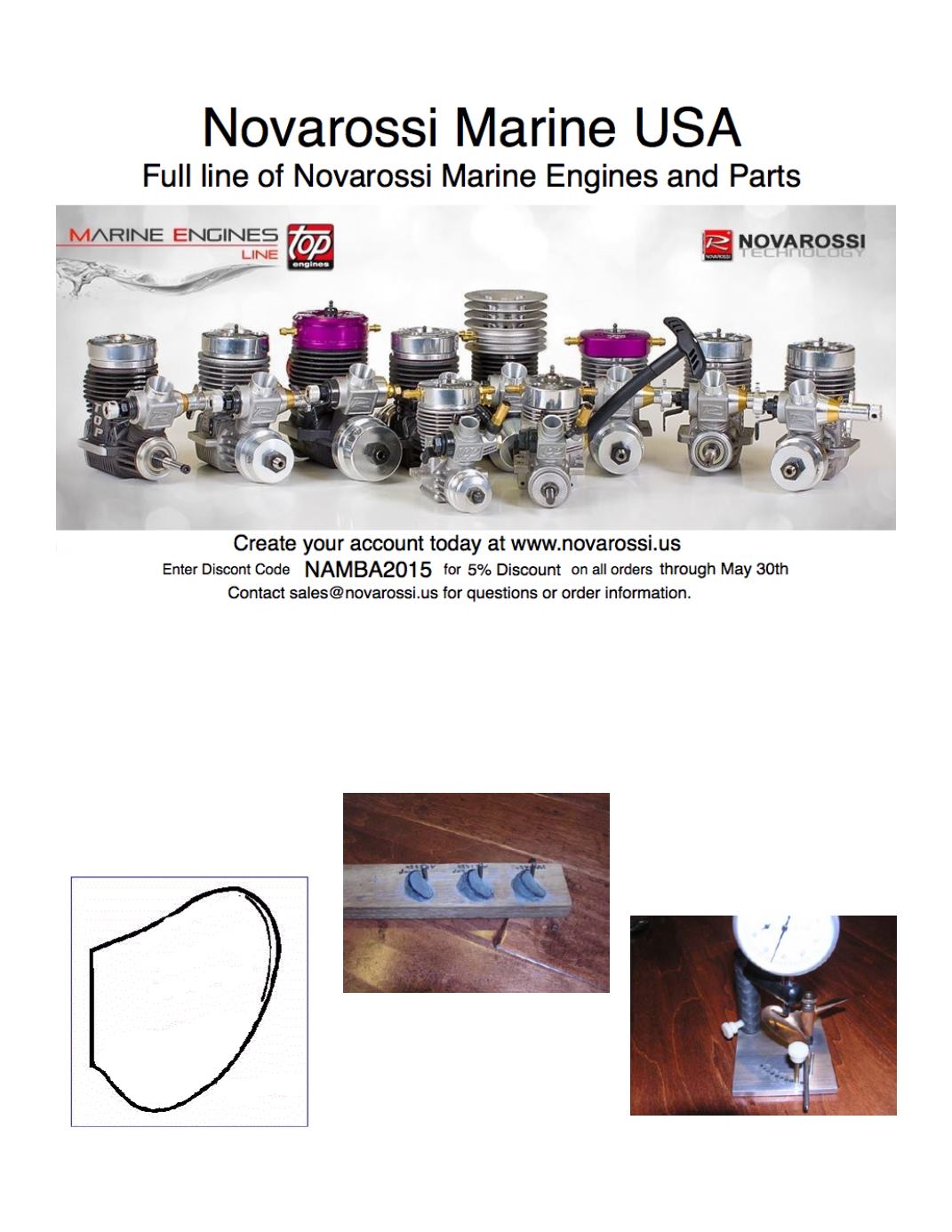
progressive pitch and edge cup pictures.
PROPWASH
10
March 2015
When you finally have the perfect
prop, how can you duplicate it? One way
is to make a model of the sternward face
out of epoxy putty. If you bend a prop,
you can often reshape the blades to fit
back on the model. This is also a handy
way to look at new props to see how
they differ. The putty shows both the
shape and blade outline.
So what is the best approach? Let’s
see what some experts do to particular
props. The first is an Octura 1475
modified by Andy Brown. As cast this
prop has a nominal diameter of 2.95” (75
mm) and a nominal pitch of 4.13”
Props
-
Part 3
(Continued from page 9)
diameter, pitch, and rpm can be
explored.
The final common modification is
curling the outside edge of the prop
along the lines shown in the drawing.
This is done to decrease the tendency of
water to flow radially off the prop.
Rake does much the same thing, and
edge cupping can be thought of as
adding rake to the outside edge of the
blade.
Edge Cup
1475 on the Pitch Gauge


